
The Necronomicon
From Lovecraftian Plot Device to Occult Grimoire and Pop-Culture Icon

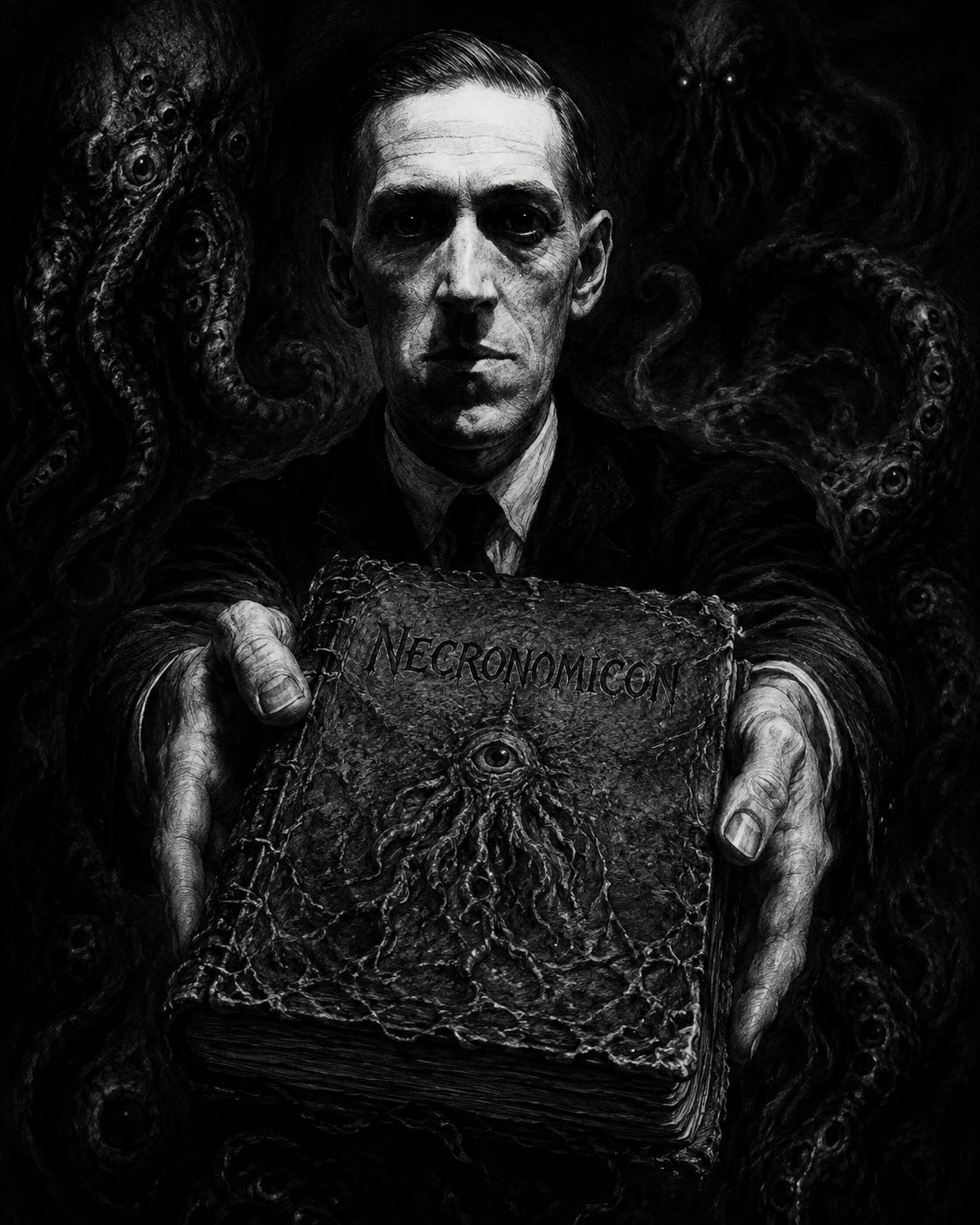
The Necronomicon is one of the strangest books in modern literary history because its influence depends on a paradox: it’s famous as a book that doesn’t exist. Invented by H. P. Lovecraft as a fictional grimoire of forbidden knowledge, it rapidly escaped the boundaries of fiction and became a shared mythic object—an imaginary text that readers, occultists, publishers, filmmakers, musicians, and game designers have treated as though it were both symbol and artifact. Its power lies not in a stable canon but in its adaptability. Lovecraft used it to create “a background of evil verisimilitude,” later occult publishers transformed it into usable ritual literature, and popular culture turned it into a shorthand for dangerous knowledge, demonic summoning, and cosmic dread.
Lovecraft first mentioned the Necronomicon in “The Hound,” written in 1922 and published in 1924, though its supposed author, Abdul Alhazred, had already appeared through a famous couplet in “The Nameless City”: “That is not dead which can eternal lie, / And with strange aeons even death may die.” Later, in “The Call of Cthulhu,” Lovecraft placed that quotation at the center of a wider mythology of buried antiquity and nonhuman powers. By presenting the line as ancient, quoted, and transmitted, Lovecraft made the Necronomicon feel less like an invented prop than a fragment of a larger archive.
Lovecraft systematized the book’s fictional history in “History of the Necronomicon,” written in 1927 and published posthumously in 1938. There he gave the work an Arabic title, Al Azif, explaining that “azif” was “the word used by Arabs to designate that nocturnal sound… suppos’d to be the howling of daemons.” The essay claims that the text was composed by “Abdul Alhazred, a mad poet of Sanaá, in Yemen,” around 700 A.D.; translated into Greek in 950 by Theodorus Philetas under the title Necronomicon; translated into Latin by Olaus Wormius in 1228; banned by Pope Gregory IX in 1232; and preserved only in a few carefully guarded library copies. The fictional bibliographic detail is the key to the illusion. Lovecraft’s fake provenance mimics the texture of real manuscript history—lost originals, banned editions, unreliable translations, and rumors of private copies.
Lovecraft also embedded the book in individual stories through brief but vivid quotations and descriptions. In “The Hound,” the narrators identify an amulet as “the thing hinted of in the forbidden Necronomicon of the mad Arab Abdul Alhazred,” linking the book to “the ghastly soul-symbol of the corpse-eating cult of inaccessible Leng.” In “The Festival,” the narrator finds “the unmentionable Necronomicon of the mad Arab Abdul Alhazred, in Olaus Wormius’ forbidden Latin translation,” a phrase that makes the book feel both scholarly and taboo. The same story includes one of Lovecraft’s most memorable pseudo-scriptural passages: “Great holes secretly are digged where earth’s pores ought to suffice, and things have learnt to walk that ought to crawl.”
In “The Dunwich Horror,” Lovecraft gives the Necronomicon a still larger cosmological role through the famous passage beginning, “Nor is it to be thought that man is either the oldest or the last of earth’s masters.” The passage continues, “The Old Ones were, the Old Ones are, and the Old Ones shall be,” and identifies Yog-Sothoth as both threshold and guardian: “Yog-Sothoth knows the gate. Yog-Sothoth is the gate.” These lines show how the book evolved from an antiquarian prop into an apparent scripture of cosmic history, one that reveals humanity as temporary, provincial, and dangerously ignorant.
Yet Lovecraft also repeatedly clarified that the book was his invention. Modern summaries of his correspondence and scholarship note that readers and even librarians sometimes treated the tome as real, a reaction encouraged by the plausibility of his invented citations. The Necronomicon therefore began as a literary technology: a way of making cosmic horror feel historically embedded. It implied that terrible truths predated the narrator, survived institutional suppression, and could be rediscovered by anyone reckless enough to read.
Lovecraft’s mock history also ends with a warning that reinforces the book’s reputation as a text whose danger lies in reading itself: “The book is rigidly suppressed by the authorities of most countries, and by all branches of organised ecclesiasticism. Reading leads to terrible consequences.” That final sentence condenses the mythology of the Necronomicon: the book is powerful because it is hidden, and it is hidden because knowledge can wound, corrupt, or reveal what human institutions cannot safely contain.
The most notorious commercial attempt to turn Lovecraft’s imaginary grimoire into a real occult book is the so-called Simon Necronomicon, first circulated in the 1970s and later widely published in mass-market form. Unlike Lovecraft’s pseudo-medieval bibliography, the Simon text connects the Necronomicon to Mesopotamian mythology and ritual language, especially Sumerian and Akkadian divine names. Its central strategy is syncretic: it presents Lovecraftian names and themes as if they were distorted survivals of ancient Near Eastern magic. In doing so, it shifts the Necronomicon from literary horror into the marketplace of modern occult practice.
The Simon version is best understood as a twentieth-century occult construction rather than a recovery of a genuine ancient book. Its appeal, however, is historically important. It gave readers something Lovecraft never intended to provide: rituals, seals, invocations, and a performable magical system. The book’s continuing fame also shows how the Necronomicon became a participatory myth. Once Lovecraft’s fictional citations persuaded readers that there might be a hidden original, later writers and publishers could profit by supplying one.
Occult author Donald Tyson developed one of the most ambitious literary-occult expansions of the myth. His Necronomicon: The Wanderings of Alhazred presents itself as a grimoire rooted in Lovecraft’s fictional universe and follows Abdul Alhazred through the Arabian desert, Irem, Babylon, the lands of the Old Ones, and Damascus. Publisher summaries describe the book as an attempt to create a Necronomicon “based purely within Lovecraft’s own fictional universe, the Cthulhu Mythos,” rather than through the Mesopotamian synthesis associated with the Simon text.
Tyson then expanded the project with Alhazred: Author of the Necronomicon, a substantial novel that imagines Alhazred’s life as an autobiographical descent into exile, mutilation, necromancy, and contact with Mythos entities such as Nyarlathotep. Later related works, including Grimoire of the Necronomicon and Tales of Alhazred, further elaborate Tyson’s version of the tradition. What distinguishes Tyson from the Simon editor is his fidelity to Lovecraftian atmosphere. Rather than claiming a recovered ancient authenticity, Tyson embraces the fictional frame and builds within it, treating Lovecraft’s invented lore as a mythic sandbox for occult fiction and ritual imagination.
Peter J. Carroll’s Epoch: The Esotericon and Portals of Chaos, created with artist Matt Kaybryn, approaches Lovecraftian material from the perspective of chaos magic. Carroll’s known for the principle that beliefs may be used as tools rather than accepted as fixed dogma; one widely quoted formulation from his work states, “In Chaos Magic, beliefs are not seen as ends in themselves, but as tools for creating desired effects.” In this context, the Necronomicon isn’t primarily a false book to expose or a true scripture to defend. It becomes a magical paradigm: a symbolic operating system that a practitioner may adopt temporarily in order to generate altered states, ritual focus, and imaginative contact with alien archetypes.
Epoch combines a book with a deck of “Portals of Chaos” cards and presents a modern chaos-magical system. Carroll’s Cthulhu Mythos paradigm describes its entities less as spirits to be commanded than as vast, nonhuman intelligences or archetypal forces approached through selective belief, gnosis, and ritualized imagination. In this model, Lovecraft’s cosmic horror is reinterpreted as magical technique. The terror of the Mythos—its emphasis on scale, alienness, and the collapse of human centrality—becomes a means of loosening ordinary categories of self and reality.
The Necronomicon has become a recurring object across horror, fantasy, music, comics, games, and visual art. Its most famous cinematic transformation is Sam Raimi’s Evil Dead series, where the Necronomicon Ex-Mortis—also called the Book of the Dead—is bound in human flesh and unleashes demonic Deadites. In The Evil Dead, Evil Dead II, and Army of Darkness, the book functions less as Lovecraftian cosmic archive than as a cursed artifact that triggers possession, slapstick gore, and apocalyptic comedy. Even so, its name instantly invokes Lovecraft’s aura of forbidden reading.
Other pop-cultural uses are more allusive. H. R. Giger titled two influential art books Necronomicon, helping establish the word as a brand of biomechanical nightmare imagery and indirectly shaping the look of Alien. The book has appeared or been parodied in works such as The Illuminatus! Trilogy, Good Omens through the joke title Necrotelecomnicon, The Simpsons, tabletop role-playing games such as Call of Cthulhu, and numerous video games that use forbidden tomes, sanity mechanics, cults, or eldritch summoning. Metallica’s “The Thing That Should Not Be” echoes Lovecraft’s famous couplet in compressed form, showing how a line attributed to Alhazred could migrate into popular music.
These references demonstrate that the Necronomicon now functions as a cultural glyph. It tells audiences, almost instantly, that a story concerns forbidden knowledge, the danger of reading, and the possibility that language itself can open doors that should remain closed. Unlike many fictional artifacts, the book’s authority increases through contradiction. One version is Arabic, another Sumerian, another Latin, another a chaos-magic deck-and-grimoire system. The lack of a single authentic text is precisely what lets the myth keep expanding.
The history of the Necronomicon is therefore not the history of an ancient grimoire but the history of a modern myth becoming materially effective. Lovecraft invented it to create depth, dread, and documentary plausibility. The Simon Necronomicon transformed that illusion into a commercial occult text. Donald Tyson returned to Lovecraft’s fictional universe and expanded it into a coherent literary-occult cycle. Peter J. Carroll reframed the Mythos through chaos magic, treating belief in Lovecraftian entities as a usable magical stance. Pop culture then multiplied the book into films, games, songs, comics, and jokes. The Necronomicon endures because it dramatizes a modern anxiety about information: some books should not be opened, yet the forbidden book is the one everyone wants to read.
Bibliography
Carroll, Peter J., and Matt Kaybryn. Epoch: The Esotericon and Portals of Chaos. Arcanorium College, 2014.
Lovecraft, H. P. “History of the Necronomicon.” 1927; first published by The Rebel Press, 1938.
Lovecraft, H. P. “The Call of Cthulhu.” Weird Tales, 1928.
Lovecraft, H. P. “The Festival.” Weird Tales, 1925.
Lovecraft, H. P. “The Dunwich Horror.” Weird Tales, 1929.
Lovecraft, H. P. “The Hound.” Weird Tales, 1924.
Simon, ed. Necronomicon. Avon Books, 1977.
Tyson, Donald. Necronomicon: The Wanderings of Alhazred. Llewellyn Publications, 2004.
Tyson, Donald. Alhazred: Author of the Necronomicon. Llewellyn Publications, 2006.
Tyson, Donald. Grimoire of the Necronomicon. Llewellyn Publications, 2008.
I cant see Cathulu without also seeing Davie jones sailing the black pearl as well.
Very informative and thorough.