
The Important Stuff, if ya Think About it
On the Diversity and Greater Purpose of Performing a Pentagram Ritual, pt.3

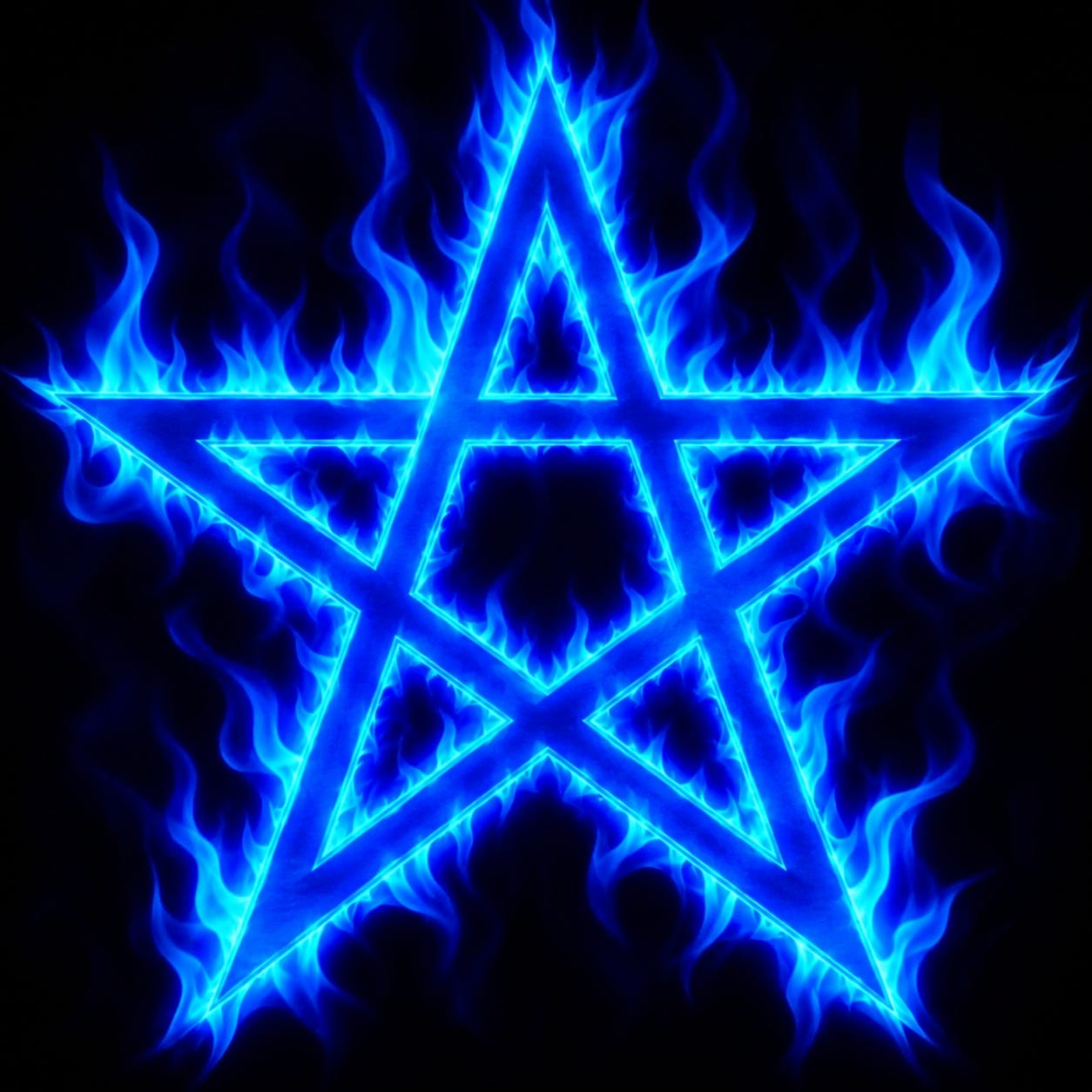
Today I’m going to write about the overall structure of the Lesser Pentagram Ritual, the underlying non-paradigmal symbolism, the various techniques employed, and how we can use that knowledge to create our own pentagram ritual using whatever paradigmal symbolism we want. I’ll start with the beginning (and ending).
The Qabalistic Cross includes some basic Qabalistic symbolism and the end of “The Lord’s Prayer” in Hebrew wrapped up in a neat bow of a physical action I’d wager every single member of the original Golden Dawn was VERY familiar with (internalized congruent symbolism). Beneath the outward symbolism, though, the Qabalistic Cross is a grounding and centering technique.
Grounding’s the practice of connecting oneself to the physical world, often symbolically to the earth, in order to steady the body and mind. In magical traditions, it’s commonly understood as a way to release excess energy, settle nervousness, and create a sense of stability before or after ritual work. Many practitioners view grounding as essential because it helps prevent feelings of overwhelm and keeps magical work connected to ordinary reality.
Centering, by contrast, is the act of gathering one’s attention and energy inward to a calm, focused point. Rather than emphasizing connection to the external world, centering emphasizes inner balance, clarity, and self-command. In magical practice, this inward focus is important because it allows intention to become more precise. A centered practitioner is better able to direct thought, emotion, and will toward the purpose of a spell or ritual.
Together, grounding and centering serve as preparatory and balancing practices that support effective magical work. They help create emotional steadiness, mental focus, and energetic balance, making ritual actions feel more intentional and controlled. Many modern guides describe them as foundational skills that prepare a practitioner for magical work, protect against distraction or energetic excess, and deepen a sense of connection between the self, the body, and the larger spiritual world. In this way, their purpose isn’t only practical but also reflective: they train the practitioner to approach magic with awareness, discipline, and presence.
Pretty much any magical paradigm you investigate will have a grounding and centering technique. After learning a few it’s also easy to create your own or adapt an existing one to your needs.
Crowley added the IAO formula to his version, as a way, so I’ve read, to replace the need for the Golden Dawn’s Lesser Ritual of the Hexagram, which I’ve read he saw as less necessary as time went on. In Western esotericism, IAO is a layered divine name whose meaning shifted across traditions. It appears in late antique sources as a Greek rendering linked to the sacred name of the God of Israel and was later adopted in Gnostic, Hermetic, and magical contexts as a name of power. More broadly, it shows how sacred language can travel between traditions and be reinterpreted through new symbolic and philosophical frameworks.
As a literary formula, IAO often functions less as a term to define than as a compact symbol of transformation. In modern occult writing, it condenses themes like emergence, dissolution, and renewal, drawing its force from suggestion, resonance, and layered association rather than direct explanation. Used this way, it shows how occult texts treat language itself as a vehicle for hidden meaning and spiritual change.
I wrote more in-depth about my thoughts on the practical use of the IAO formula in the first section of this post:

After the Qabalistic Cross comes what I referred to as ‘the formulation of the Pentagrams’ section. It’s easy to view this part as a simple circle casting, but there’s actually a lot of symbolism going on here. In various magical traditions, the circle is often associated with wholeness, eternity, protection, and the containment of power. Because it has no beginning or end, it easily becomes a symbol of the infinite, the cyclical nature of time, and the unity underlying apparent divisions. This is one reason circles are frequently linked with consecrated space, cosmic order, and the boundary between the ordinary world and a ritual field. In symbolic terms, the circle suggests both enclosure and inclusion: it protects what is within, while also expressing the idea that all parts belong to a greater whole. The symbolism of the circle is also quite deeply internalized in most people.
The pentagram, a five-pointed star drawn with five continuous lines, has carried many meanings across history, but in magical practice it’s most often understood as a symbol of order, protection, and the relationship between the human being and the cosmos. Rather than having one universal meaning, the pentagram takes on different interpretations depending on the ritual system, historical period, and orientation in which it appears.
The pentagram appears in ancient Mediterranean and Near Eastern contexts long before its modern occult associations. Over time it came to be linked with ideas of harmony, health, and wholeness, including in the Pythagorean tradition. In medieval and early modern Europe, it was also used as an apotropaic sign, a mark intended to ward off harmful influences. Later ceremonial and esoteric traditions adopted it more explicitly as a ritual emblem, treating it as a diagram of cosmic balance and controlled spiritual force.
For our purposes, I think these are the core symbolic meanings:
Protection: One of the most widespread magical meanings of the pentagram is protection. It’s often used in ritual diagrams, amulets, and visualizations to establish boundaries and repel unwanted influences.
Microcosm and humanity: In some esoteric systems, the five points correspond to the human form—head, arms, and legs—making the symbol a representation of the human being as a microcosm of the universe.
The elements: Many magical traditions associate the five points with earth, air, fire, water, and spirit. In this reading, the pentagram represents the ordering of material and spiritual forces into a coherent whole.
Harmony and balance: Because of its geometric symmetry and long association with proportion, the pentagram is also read as a symbol of equilibrium, disciplined will, and the alignment of inner and outer realities.
The Evocation of the Archangels section is a typical ‘Quarter Call’. In many forms of ceremonial magic, Wicca, and other Pagan traditions, quarter calls are used at the beginning of a ritual to invite the powers associated with the four cardinal directions into the working space. These directions are commonly linked with the classical elements—Earth, Air, Fire, and Water—and are often understood as sources of specific qualities ascribed to each element. By calling the quarters, practitioners symbolically mark out sacred space and align the ritual with a larger cosmic order.
The purpose of this practice is usually twofold: protection and attunement. Quarter calls are often intended to establish a boundary around the ritual circle, helping practitioners further focus and separate the rite from ordinary space. At the same time, they’re used to invite balance and support from the elemental forces or guardians associated with each direction. Depending on the tradition, these forces may be seen as symbolic energies, spiritual intelligences, or ritual archetypes. Although the exact wording and correspondences vary, quarter calls generally function as a way to prepare, protect, and empower magical work.
Crowley replaced the archangels with guardians from The Chaldean Oracles. The Chaldean Oracles, often called in older English editions The Oracles of Zoroaster, present a cosmology in which divine power reaches the material world through a hierarchy of intermediaries. Though the original poem survives only in fragments quoted by later Neoplatonists, it became one of the central texts of late antique theurgy. Its hierarchy of Iynges, Synoches, Teletarchs, and Daemons explains both how divine causation descends into the cosmos and how the soul may ascend again toward its source. The basic principle is that the highest reality is too transcendent to touch the lower world directly, so communication happens through graduated ranks that transmit, bind, govern, and mediate divine power.
The Iynges stand closest to the intelligible fire of the Father. They’re described as swift noetic powers or divine “thoughts” proceeding from the paternal source while remaining oriented toward it. For this reason, they symbolize transmission without separation: the first outward communication of divine ideas into the cosmos.
The Synoches, whose name suggests “connectors” or “holders-together,” represent cohesion and continuity. If the Iynges express the outgoing flash of divine intellection, the Synoches preserve the bonds that hold the levels of reality together. They maintain cosmic order and the sympathetic link between higher and lower worlds, making both providence and spiritual ascent possible.
The Teletarchs are ruling powers associated with completion, consecration, and governance over the structured regions of the cosmos. Whereas the Iynges transmit and the Synoches bind, the Teletarchs order and delimit. They ensure that divine principles are expressed in a hierarchically organized universe, a crucial idea in theurgical systems where ritual depends on a responsive cosmic order.
The Daemons occupy the lowest and most ambiguous level of the hierarchy. In late antique thought, daemons were intermediary spirits rather than necessarily evil beings, but in the Chaldean Oracles their realm is spiritually risky because it lies close to matter, passion, and illusion. They mediate influences in the sublunary world, yet they can also entangle the soul if lower images are mistaken for higher truth. They therefore mark the threshold of embodiment and the need for discernment in spiritual ascent.
Taken together, these four orders form a ladder of descent and return: the Iynges communicate divine intellect, the Synoches preserve connection, the Teletarchs govern cosmic structure, and the Daemons mediate near embodied life. The hierarchy shows that in the Chaldean Oracles transcendence doesn’t exclude nearness, because the divine acts through graduated powers. At the same time, it presents salvation as a disciplined ascent through the very structure by which reality unfolds, making the hierarchy both a map of the cosmos and a guide to the soul’s return to intelligible fire.
These guardians aren’t explicitly elemental. Then again, neither is The Star Ruby. If you’re like me, you’ve likely seen versions of the LRP with angels, demons, watchtowers, elemental kings, spirit animals, fairies, the four winds, and various archetypes far too numerous to list. The important thing to consider, when creating your own ritual, is to make the quarter guardians coherent with the rest of the ritual and something deeply internalized that truly fortifies your space (for you).
This section, as well as the drawing of the pentagrams in the previous one, also establish a square in the ritual space. The square usually symbolizes foundation, stability, limitation, and manifestation in the material world. Its four equal sides and fixed angles make it a natural emblem of order, balance, and constructed form. Esoteric systems often connect the square with the four directions, the four classical elements taken together, or the fourfold organization of the visible world. If the circle points toward the unbounded, the square points toward what is grounded, measured, and built. In magical symbolism, it can therefore stand for the temple, the altar, the body, or any form through which spiritual force is given durable shape.
After that, when you say “For about me flames the pentagram, and above me shines the six-rayed star” (assuming you like your reference to the element of ‘spirit’ or ‘aether’ above you like I do) you’re implying a pyramid shape, connecting all five elements. The triangle’s often read as the most dynamic of the three shapes we’ve used here. With its upward point, it can symbolize ascent, aspiration, directed force, and the movement from multiplicity toward unity. In alchemical symbolism, triangles are used to denote elemental qualities such as fire and water, with added lines marking air and earth. The triangle is also frequently interpreted as a figure of triads: body, soul, and spirit; birth, life, and death; or thesis, antithesis, and synthesis. When extended into three dimensions as a pyramid, the symbolism becomes even more pronounced. The pyramid suggests elevation, concentration, hierarchy, and the gathering of force from a broad base toward a single apex. In magical and esoteric interpretation, this can represent the raising of consciousness, the ordering of levels of reality, or the refinement of raw experience into focused spiritual/magical intention.
Taken together, these three forms can be read as a sequence of symbolic functions within magical thought: the circle establishes sacred totality or protected space, the square gives form and stability to what is invoked, and the triangle or pyramid directs energy toward transformation or ascent. Their meanings vary by tradition, but they recur because they offer a simple visual language for expressing some of the most enduring concerns of esoteric practice: unity, order, embodiment, and change.
Lastly, we don’t want to overlook the spoken words of the ritual. They’re worth considering. In the history of ritual magic, the phrase “barbarous tongues” usually refers to strange, foreign, or seemingly nonsensical words used in chants, invocations, and spells. Scholars often connect these expressions with the voces magicae found in the Greek Magical Papyri and related traditions, where the power of the utterance was often believed to lie less in ordinary meaning than in sound, rhythm, and ritual force.
I realize Hebrew may not be exactly what you think of a ‘barbarous’, or Crowley’s use of Greek in the Star Ruby, though from things I’ve heard and read Crowley’s Greek might be a bit more ‘barbarous’ than one would think. Unless these languages happen to be what you normally speak in they do accomplish the intended purposes, however.
One purpose of these words is to mark ritual speech as different from everyday language. Because the phrases are often obscure or difficult to understand, they can create a sense of entering a special verbal space, something set apart from common conversation. In this way, “barbarous” speech helps establish atmosphere, seriousness, and psychological focus within the rite.
A second purpose is sometimes preservation. In many traditions, sacred names and formulas are thought to lose power if translated or altered. Authors such as Iamblichus argued that foreign or inherited divine names should remain unchanged because their efficacy was bound to their exact sound. From this perspective, the strange wording was not a defect but a sign that the formula had been faithfully transmitted.
A third purpose is performative and sensory. Repeated vowels, dense consonants, and forceful rhythms can heighten concentration, emotion, and bodily engagement. Later occult writers also emphasize that sonority itself matters: long, resonant strings of words could help lift consciousness, intensify attention, and give ritual speech a feeling of potency beyond plain prose. This is the reason some words are often ‘vibrated’.
Historically, these expressions also reflect cultural mixing. Many “barbarous” names in ancient magic seem to come from Egyptian, Hebrew, Persian, Greek, and other linguistic sources, sometimes preserved accurately and sometimes transformed through copying and pronunciation. Their very strangeness could signal contact with ancient, foreign, or sacred authority.
Viewed critically, then, the purpose of “barbarous tongues” in magical work can be understood in several overlapping ways: they separate ritual from ordinary speech, preserve inherited formulas, enhance sound and performance, and lend an aura of mystery and antiquity. Whether one interprets them spiritually, psychologically, or historically, their function isn’t simply to “say nonsense,” but to make language act differently inside ritual.
Grand post!!