
Stephen Mace and the Engineering of Modern Sorcery
Liberation Through Magical Autonomy

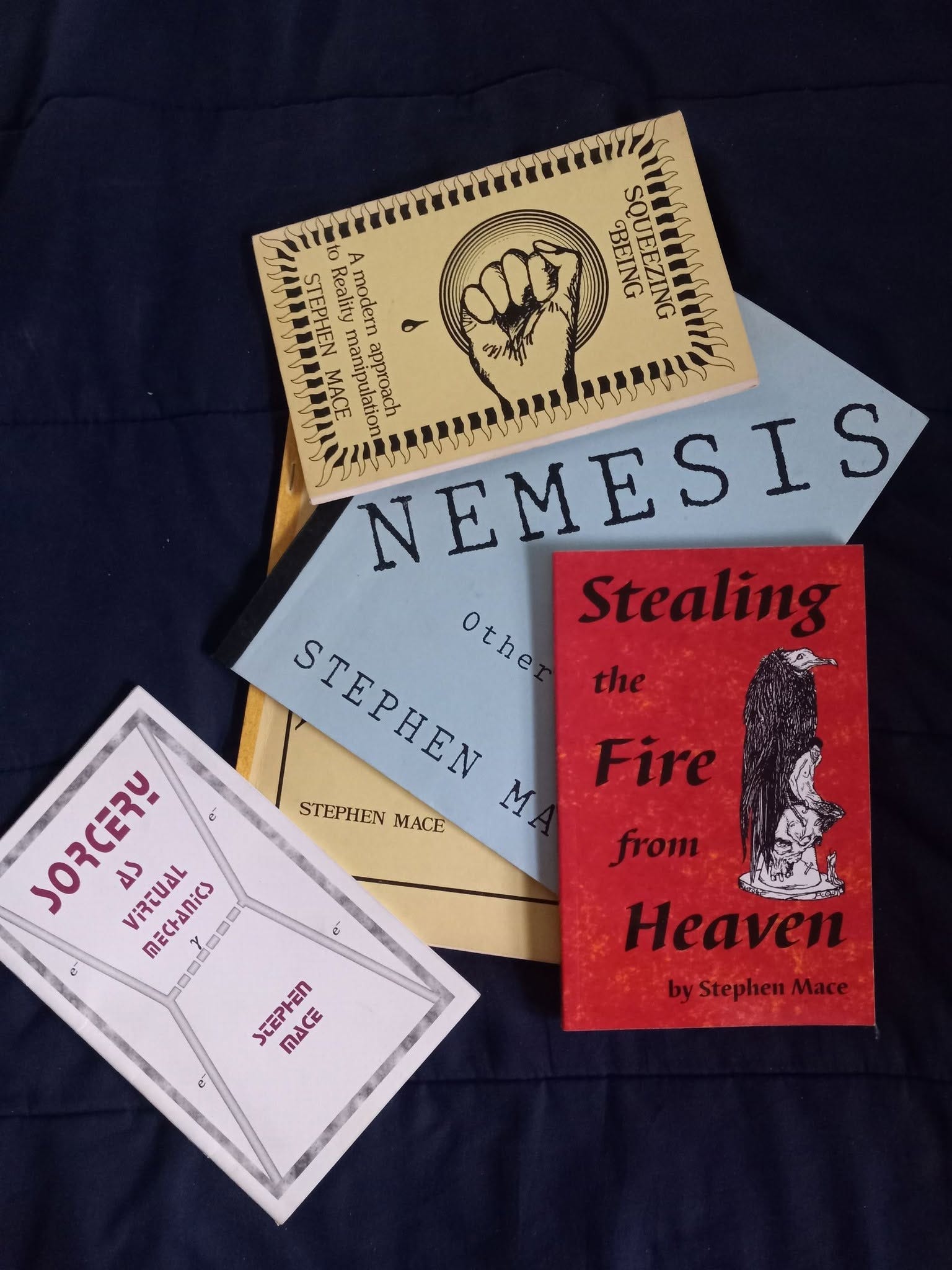
The pic above is a partial display of my Stephen Mace collection. The rest are digital and wouldn’t make a good picture. I posted books because I’ve never seen a photo of Mace and presume he’s like Pete Carroll in that respect.
Stephen Mace occupies a distinctive place in late twentieth- and early twenty-first-century occult writing: he’s less a popularizer of inherited ceremonial systems than a theorist of self-authored magical practice. His best-known books—Stealing the Fire from Heaven, Shaping Formless Fire, Taking Power, and Seizing Power—present magic not merely as ritual performance, but as a disciplined method for transforming perception, will, symbolism, and personal sovereignty. Although Mace is often associated with chaos magic, his work isn’t reducible to slogans about belief as a tool. It’s more precise, more psychological, and more political than that: he asks how a practitioner might construct a symbolic technology that’s intensely personal, operationally useful, and resistant to external domination.
Mace’s writing emerges from the broad modern occult current shaped by figures such as Aleister Crowley and Austin Osman Spare, but it also reflects the experimental temper of chaos magic. Rather than insisting on one fixed cosmology, Mace treats occult practice as a set of techniques for engaging hidden layers of consciousness and reality. His recurring vocabulary—fire, power, form, sorcery, liberty, divinity—signals an interest in raw potential: the unformed energies of the psyche and world that can be contacted, shaped, and directed through practice.
This approach makes Mace’s occultism practical without being merely mechanical. He’s concerned with method, but also with ownership: who designs the symbols, who authorizes the ritual, who defines the goal, and who benefits from the power released. For Mace, magical technique is inseparable from freedom. The magician isn’t simply someone who performs ceremonies, but someone who reclaims the right to define meaning and act from the depths of the self.
Stealing the Fire from Heaven is Mace’s signature work and the best introduction to his occult philosophy. Subtitled A Technique for Creating Individual Systems of Sorcery, it argues that effective magical practice should arise from the practitioner’s own unconscious symbolic language rather than from borrowed systems alone (Mace, Stealing the Fire from Heaven). The book is commonly described as a concise but influential manual that draws on Spare’s sigil work and Crowleyan magical theory while pushing both toward a more individualized model (Mace, Stealing the Fire from Heaven).
The Promethean title is important. To “steal fire from heaven” is to seize creative power from a remote or external authority and bring it into human use. Mace’s “fire” isn’t simply supernatural force; it’s the potency of the subliminal self, the capacity to generate symbols that bypass ordinary rational resistance and communicate with deeper strata of mind (Mace, Stealing the Fire from Heaven). In this sense, the book turns sorcery into a language problem: the magician must discover or invent signs that the unconscious recognizes as its own.
What makes the work enduring is its balance between theory and procedure. Mace doesn’t merely praise intuition; he proposes a way to make intuition operational. His influence lies in presenting personal magical systems as deliberate constructions rather than vague expressions of preference (Mace, Stealing the Fire from Heaven). The practitioner becomes a designer of inner technology, shaping a private grammar of power from dream, desire, symbol, repression, and focused intent.
Shaping Formless Fire: Distilling the Quintessence of Magick expands the central metaphor of fire into a broader meditation on magical essence and form. If Stealing the Fire from Heaven emphasizes the creation of a personal system, Shaping Formless Fire asks how raw possibility becomes usable magical structure (Mace, Shaping Formless Fire). The title suggests a paradox at the heart of Mace’s thought: the magician works with something fluid, elusive, and preconceptual, yet must give it enough form to act in the world.
In this respect, Mace’s work has affinities with both art and engineering. The occultist isn’t simply a believer in unseen forces, but a craftsperson who learns how images, gestures, names, and states of consciousness alter experience. The “formless fire” can be read as psychic energy, imaginative force, or magical potential; shaping it means creating reliable channels through which intention can move (Mace, Shaping Formless Fire). Mace’s practical contribution is to frame magical work as disciplined experimentation rather than passive faith.
The companion-like titles Taking Power: Claiming Our Divinity Through Magick and Seizing Power: Reclaiming Our Liberty Through Magick make explicit what is implicit throughout Mace’s earlier work: magic is a struggle over authority (Mace, Taking Power; Mace, Seizing Power). These books emphasize the ethical, spiritual, and political dimensions of occult practice. To take power, in Mace’s vocabulary, isn’t simply to dominate others. It’s to reclaim agency from systems—social, religious, psychological, and cultural—that teach people to experience themselves as powerless.
Taking Power links magic with divinity, suggesting that the human being contains a sacred or godlike capacity for creation (Mace, Taking Power). This doesn’t necessarily require conventional theology. Rather, Mace’s language of divinity points to the radical implications of magical autonomy: if the practitioner can generate symbols, shape consciousness, and direct will, then the practitioner participates in creation. The divine isn’t merely worshiped; it’s enacted.
Seizing Power, by contrast, foregrounds liberty. Its subtitle, Reclaiming Our Liberty Through Magick, frames occult practice as an act of resistance (Mace, Seizing Power). Mace’s concern isn’t only inner transformation but liberation from imposed meanings and compulsory obedience. His political edge distinguishes him from occult writers who treat magic solely as private self-improvement. For Mace, the personal magical system is also a declaration of independence.
Mace’s wider bibliography reinforces these concerns. Sorcery as Virtual Mechanics develops the idea that occult operations can be understood as the actualization of unseen forms, a phrase that captures his interest in invisible structures becoming effective realities (Mace, Sorcery as Virtual Mechanics). Squeezing Being: A Modern Approach to Reality Manipulation suggests a similarly experimental attitude toward the nature of reality and the practitioner’s role in shaping it. Collections and essays such as The Magick in the Music and Other Essays, Addressing Power, and Nemesis & Other Essays show Mace working across occult theory, culture, and the politics implied by magical practice (Mace, The Magick in the Music and Other Essays).
These works matter because they show that Mace’s project isn’t confined to a single manual or technique. He repeatedly returns to the same cluster of questions: How does intention become form? How does the unconscious communicate? How can magical practice escape inherited dogma without collapsing into randomness? How can power be claimed without becoming merely another system of coercion? The consistency of these questions gives his body of work a recognizable philosophical shape.
Mace’s style is notable for its compactness. He isn’t primarily a mythographer or a storyteller; he writes like someone trying to isolate the working parts of magical experience. This can make his books demanding, especially for readers seeking broad historical surveys or lavish ritual scripts. Yet the same compression gives his work its force. His books ask readers to think like practitioners: to test, design, revise, and assume responsibility for the symbolic systems they use.
His significance within modern occultism lies in his fusion of psychology, technique, and sovereignty. Mace helps shift attention from inherited magical authorities to the practitioner’s own deep structure of meaning. In doing so, he stands in the lineage of Spare’s sigil magic and chaos magic’s experimentalism, while retaining his own emphasis on power as both inner capacity and political condition. His work appeals especially to readers who want occultism to be more than belief: a craft of perception, a discipline of symbolic invention, and a means of self-rule.
Representative Quotations
“This essay offers a technique that individuals can use to create their own systems of sorcery, systems precisely tailored to fit their own unconscious minds.”
This description of Stealing the Fire from Heaven captures the central thrust of Mace’s method: magic becomes powerful when it is adapted to the practitioner’s own symbolic and unconscious structure rather than imposed from outside (Mace, Stealing the Fire from Heaven).
“The result will be what is essentially a personal language of power, one that has meaning only for his or her self, but full of potency because it is his or her own soul’s way of expressing itself.”
This sentence clarifies why Mace’s work has remained important to readers interested in chaos magic and self-directed sorcery: the goal is not simply to borrow signs but to generate a living symbolic vocabulary (Mace, Stealing the Fire from Heaven).
“Magick is a psychic technology, a collection of observations about psychic energy and the techniques for manipulating it.”
That formulation, associated with Shaping Formless Fire, helps explain the technical tone of Mace’s writing. He treats magical practice as disciplined work with attention, psyche, desire, and force rather than as mere belief or inherited ceremony (Mace, Shaping Formless Fire).
Stephen Mace’s occult writing is best understood as a sustained argument for magical autonomy. From Stealing the Fire from Heaven to Shaping Formless Fire, from Taking Power to Seizing Power, he returns again and again to the image of power hidden within the individual and waiting to be claimed through disciplined symbolic work. His books aren’t merely manuals of technique; they’re manifestos for self-created sorcery. Mace’s enduring contribution is his insistence that magic becomes most potent when it speaks in the practitioner’s own language, arises from the practitioner’s own depths, and serves the practitioner’s own liberation.
Bibliography
Mace, Stephen. Stealing the Fire from Heaven: A Technique for Creating Individual Systems of Sorcery. Dagon Productions and Heathen World Productions, revised enlarged ed., 2006.
Mace, Stephen. Seizing Power: Reclaiming Our Liberty Through Magick. New Falcon Publications, 2006.
Mace, Stephen. Taking Power: Claiming Our Divinity Through Magick. New Falcon Publications, 2007.
Mace, Stephen. Shaping Formless Fire: Distilling the Quintessence of Magick. New Falcon Publications, 2019.
Mace, Stephen. Sorcery as Virtual Mechanics: The Actualization of Unseen Forms in Occult Working.
Mace, Stephen. The Magick in the Music and Other Essays. New Falcon, 2022.
A symbolic system built to fit one particular soul doesn't generalize into a claim on anyone else's obedience, since it was never designed to. That's actually the same test worth applying to any framework someone builds, spiritual, political, therapeutic.
Does the power stay proportional to the self that generated it, or does it start requiring other people to submit to a private grammar they never agreed to speak? Mace's fire being stolen from heaven rather than handed down from it seems like the right posture either way. Nobody granted it. Nobody else gets to revoke it.
Thanks I have never heard of him. I now have a new source of knowledge!!