
Bi-Planetary Deities & You
Hybrid Planetary Powers, Chaos Magic, and the Making of a Modern Pantheon in Peter Carroll’s Epoch

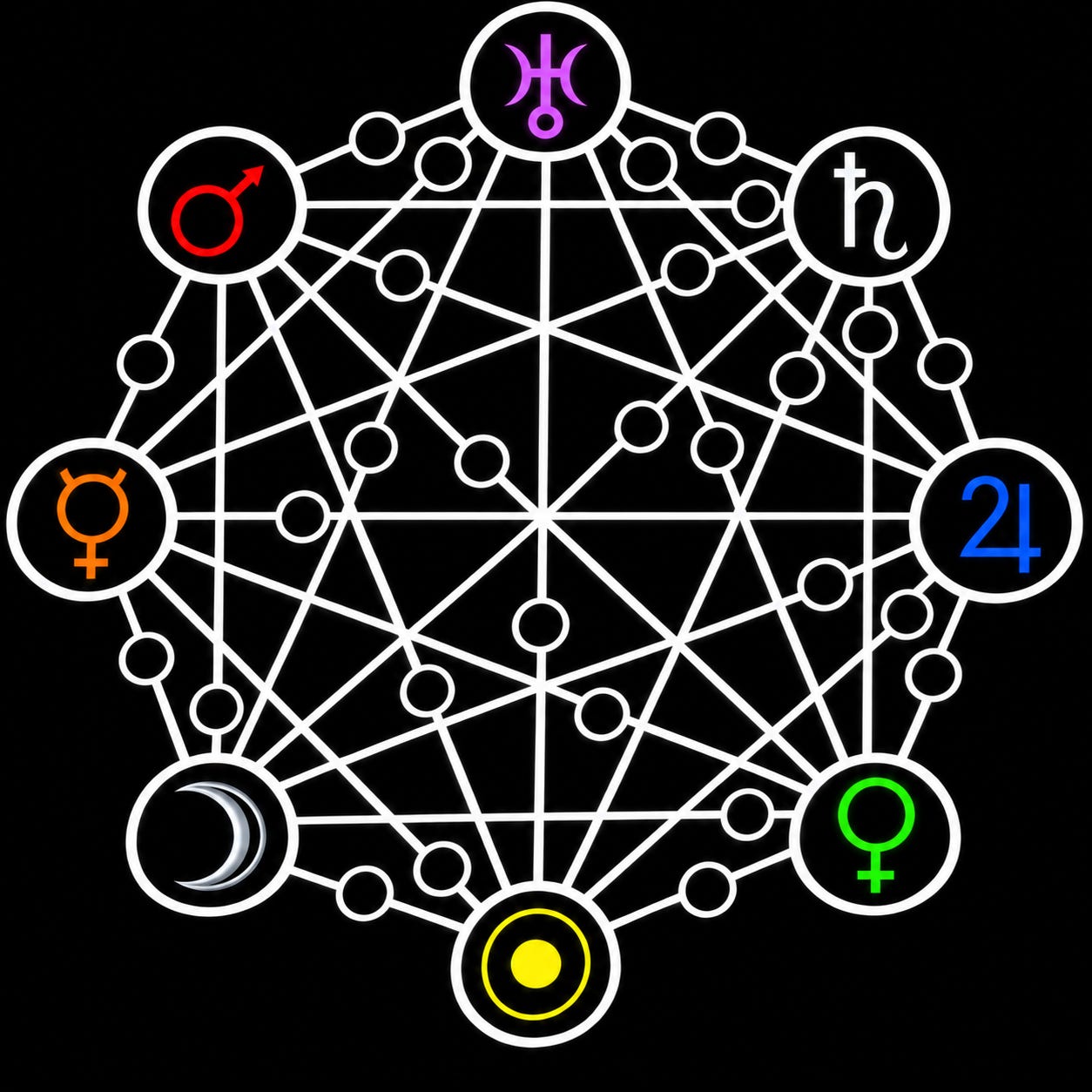
Peter J. Carroll’s Epoch, created with Matt Kaybryn, presents a deliberately modern magical cosmology: a pantheon, a set of images, and a ritual architecture meant to speak to contemporary practitioners rather than merely preserve inherited occult systems. At the center of its originality is the idea of bi-planetary deities—god-forms generated not from a single planetary force, but from the combination of two planetary principles.
Epoch contains an elemental, planetary, and Lovecraftian set of grimoires, supported by the visual system of the Portals of Chaos card deck. It offers a “pantheon for the present day” and its exploration of bi-planetary sorcery revives a central but comparatively neglected feature of Renaissance magic. In this context, the bi-planetary deities aren’t decorative additions to an older system. They’re a core mechanism by which Carroll reorganizes magical correspondence into paired, dynamic forces.
Traditional planetary magic often treats planets as discrete powers: Mars for conflict and force, Venus for attraction and harmony, Mercury for communication and agility, Saturn for structure and limitation, and so on. Carroll’s bi-planetary model complicates that pattern by treating divine forms as products of relationship. A deity generated from two planetary currents isn’t simply “half one thing and half another.” Rather, it embodies the tension, fusion, contradiction, and productive exchange between two archetypal tendencies.
This is significant because a paired system better reflects how people actually experience symbolic forces. Desire rarely appears without strategy; discipline may coexist with imagination; violence can masquerade as justice; wisdom may need communication to become useful. By assigning deities to planetary pairings, Epoch encourages the magician to think in combinations rather than isolated categories. The result is a more relational pantheon, one in which divine figures dramatize processes, dilemmas, and syntheses rather than single fixed traits.
From a Chaos Magic perspective, a deity needn’t be accepted as a historically continuous supernatural personage in order to be useful. A deity can function as an interface: a deliberately constructed form through which the magician concentrates attention, emotion, imagination, and intent. The bi-planetary deities of Epoch therefore show Carroll’s characteristic pragmatism. They’re old enough to resonate with astrological and mythic tradition, but new enough to avoid being trapped by inherited dogma.
The phrase “pantheon for the present day” is useful here because Carroll’s project doesn’t merely update the gods. It updates the logic by which gods are organized. Instead of arranging divinity through a traditional Tree of Life, a classical pantheon, or a fixed theological hierarchy, Epoch proposes a “Chaobala”—a chaos magic-inflected map of correspondences. Bi-planetary deities serve as nodes within that map, helping practitioners move between psychological insight, ritual action, and mythic imagination.
The importance of bi-planetary magic lies partly in its historical suggestiveness. Renaissance occultism often depended on correspondences among planets, metals, angels, spirits, virtues, times, and ritual operations. Those correspondences were rarely simple. Magical forces were imagined as layered and interdependent, not merely as one-to-one labels. By foregrounding pairings of planetary powers, Carroll recovers some of that complexity while translating it into the language of contemporary Chaos Magic.
In practice, such deities can be approached as ritual masks for specific kinds of transformation. A practitioner might invoke a bi-planetary figure when ordinary categories feel too blunt: when the goal requires both courage and diplomacy, both restraint and inspiration, both analysis and passion. The deity becomes a symbolic technology for holding complexity. Rather than simplifying inner conflict, it gives that conflict an image, a name, and a ritual frame.
Before moving on, here’s a post about the same subject I wrote on January 1, 2025:

It’s worth clicking because it shows some pictures and discusses some of the deities in the pantheon. Examples help show how the system works. I should point out this is my take on these deities and doesn’t necessarily correspond with Carroll’s in every way. Eris, the Martial-Venusian deity of the system, for instance, wouldn’t merely combine aggression with attraction; it would dramatize the charged field where desire, conflict, seduction, rivalry, and creative tension meet. Such a deity could represent the power of magnetism under pressure: the impulse to pursue, compete, charm, conquer, reconcile, or transform passion into action.
Anubis, Carroll’s Mercurial-Saturnine deity would suggest a very different kind of god: one concerned with disciplined intelligence, coded knowledge, strategic speech, contracts, calculation, and the hard limits placed on thought and communication. Where Mercury alone may indicate speed, wit, and exchange, Saturn slows and structures that movement. The resulting figure becomes an image of severe reason, guarded language, or the occult power of boundaries placed around information.
Hopefully these examples help to clarify why the bi-planetary model is more than an expanded list of correspondences. Each pairing creates a mythic personality from the friction between two powers. The deity is born from the relation itself: Mars doesn’t simply sit beside Venus, nor Mercury beside Saturn; each pair produces a third symbolic field that can be contemplated, invoked, or used as a ritual lens. In this way, Epoch turns planetary magic into a grammar of hybrid divine forms.
(Edit: A full list of the deities from Epoch would have been cumbersome, so I didn’t include one. If you’re interested in what one is, message me.)
I will point out that there are I don’t agree with Carroll’s choices for the pantheon in every instance, and I do feel like the idea of bi-planetary deities is far more important than the specific deities he chose. That’s how I’d suggest it be used.
As an example, way back in Liber KAOS, Carroll referred to Thanateros as Lunar-Saturnine, so I was excited, decades later, when Epoch was published. However, when you flip to the Lunar-Saturnine deity in Epoch you get Hecate. Hecate’s a fine Goddess, don’t get me wrong, but if I’d named my occult social club after a deity I created that represented Sex and Death I’d have put ‘em in my book.
The strength of Carroll’s bi-planetary deities is that they invite creative precision. They’re not vague archetypes floating free of structure; each is rooted in a formal scheme of planetary combination. At the same time, they’re not bound to a single inherited mythology. This makes them especially compatible with Chaos Magic, which values experimental use over doctrinal purity. The magician can treat them as symbolic hypotheses to be tested through meditation, invocation, divination, or artistic contemplation.
Yet the same flexibility can also be a limitation. Readers who seek historically stable gods may find Carroll’s system too synthetic, while readers without a grounding in planetary symbolism may find its combinations difficult to decode. Because the deities are part of a constructed magical architecture, their meaning depends on understanding the wider system. The bi-planetary figures are therefore not casual symbols; they ask the reader to participate in the logic of the whole work.
Bi-planetary deities in Peter Carroll’s Epoch represent more than an unusual occult classification. They reveal a wider ambition: to construct a modern pantheon adequate to complexity, hybridity, and experiment. By combining planetary powers into divine forms, Carroll offers a way of thinking magically about relationship rather than essence, process rather than static identity. In doing so, Epoch reframes deity as a living symbolic instrument—one that can draw on ancient correspondences while remaining open to the needs, conflicts, and inventions of the present.